Why Crimson Desert is an Open-World RPG that Modern Gamers Like
There are not many games that gamers can spend more time exploring and making them curious about what’s in them, and Crimson Desert is one of the many games currently available. Developed by Pearl Abyss, the studio behind the trending game Black Desert Online, this game apparently had significant changes during its development period.
Initially this game was designed as a prequel to Black Desert Online. However, on the way, Pearl Abyss gave a new breakthrough by ditching the live-service elements and reproducing Crimson Desert as an independent narrative game based on a Single-player Action RPG which was released March 19, 2026.
This makes the game not dependent on Black Desert lore. Anyone can immediately try Crimson Desert without needing to study the previous game.
How to Get Crimson Desert Steam Key
For PC players who are ready to dive into Pywel, get it Red Desert Steam Key via LootBar is a practical option. LootBar is a game keys shop that is known for its fast response and safe transactions — two things that are important when buying keys for games that are trending among today’s gamers. New customers can get discounts of up to 20%, making LootBar the perfect place to go before adventuring in Pywel.
In addition to the Crimson Desert Steam key, Looting Rod also provides various game keys for other genres and platforms, so it is worthy of being a subscription store for purchasing games in the future.
How to Build a Pywel World That Feels Realistic
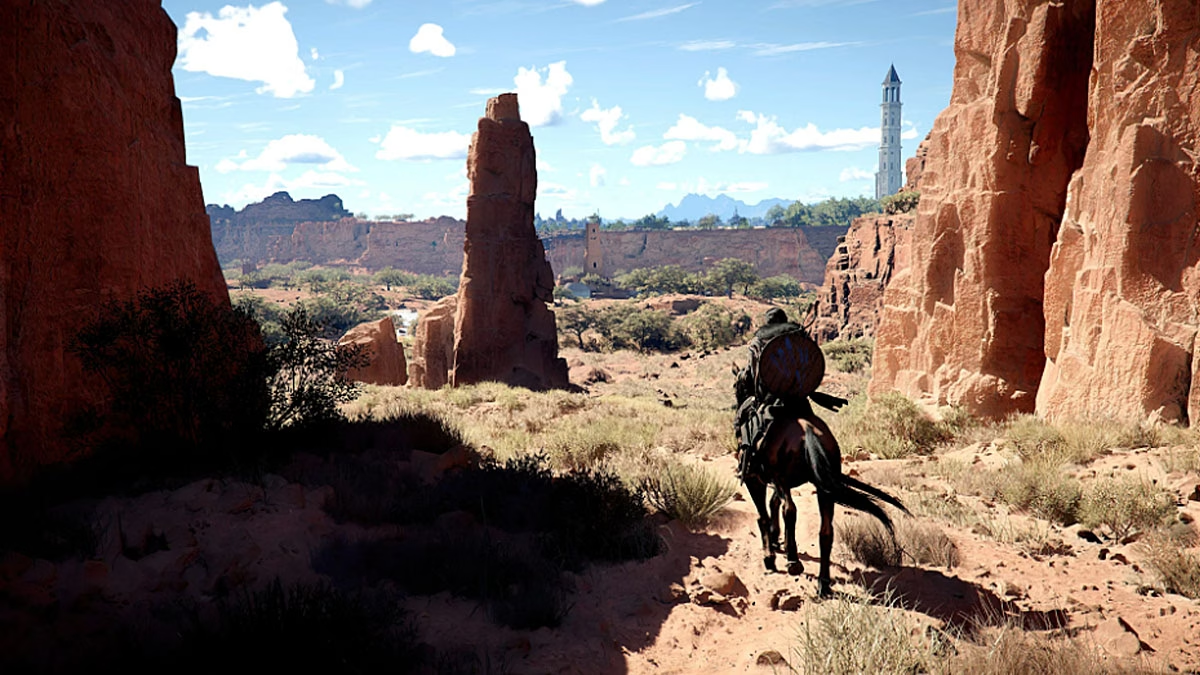
The game is set on the continent called Pywel — a vast landmass divided into five main regions: Hernand, Pailune, Demeniss, Delesyia, and the Crimson Desert itself. Each region has its own character. Not only are the visuals different, but also the atmosphere, architecture, threats and political dynamics that shape the way players interact with the surrounding environment.
The starting area, Hernand, already feels big and alive. The cities are bustling, ruins are scattered in corners not indicated by the main quest, and there’s a sense that the world is constantly moving even when the player isn’t paying attention. Environmental puzzle hidden behind rocks and old buildings. Treasure awaits in undetectable places on the map.
Pearl Abyss built Pywel not as an icon on a map, but as a place with its own characteristics. Curiosity is more than just following directions — and that’s what makes the world feel different from many other open-worlds.
Kliff and the Weighty Story
Players take on the role of Kliff, leader of the Greymanes mercenary faction — a group known for their swordsmanship and reputation for helping those in need. The game starts not from glory, but from defeat. An ambush disrupts the faction, and Kliff must regroup the scattered members while dealing with Pywel’s increasingly unstable political dynamics.
A starting point like this gives the story a pillar that players can understand. Kliff isn’t a hero just discovering his destiny — he’s a veteran rising from rock bottom, surrounded by supporting characters who each bring their own problems.
As the story progresses, elements of the Abyss start to creep in. The Abyss is a realm of floating islands above Pywel, and artifacts from there have fallen to the world below — granting those who possess them incredible powers. This mechanic affects both narrative and combat, and ensures the game’s direction is less predictable.
Combat System that Evolves with the Player
Pearl Abyss has long been known for building a combat system that is both capable and deep to learn, and Crimson Desert continues that tradition. Weapon choices include swords and shields, greatswords, spears, axes, and long-range weapons. What makes this combat special is not the variety of types, but how it is all connected.
Combat progresses from weapon to weapon, from punch to kick, from kick to slam, all in a chain that can be customized and developed over time. Fighting regular enemies can be something different once players start to understand the patterns. Fighting bosses is a different matter.
Each big boss is equipped with an Abyss Artifact that provides unique abilities. Defeating them requires an understanding of attack patterns, the right parry timing, and the right moment. Levels and powerful gear seem optional — the game demands active engagement with its combat system.
Gear progress takes place through three paths: purchasing from merchants, getting it on certain maps, and crafting using materials from hunting, mining, and completing quests. Pearl Abyss says the main quest only represents a small portion of the total content available — something that seems promising considering how dense the game’s initial region alone is.
Regarding traversal, this game develops gradually. The beginning of the journey was spent on foot and horseback. Over time, the abilities to climb cliffs, soar through the air using magic, ride dragons, and pilot super-powered giant mechs all unlock — each changing the way players relate to the Pywel landscape.
Conclusion: Time Spent Pays Off
A truly successful open-world RPG is one that makes the entire content look exciting — big doesn’t mean it’s for the sake of looking innovative, but big because there are truly epic things in it. Crimson Desert seems to fall into the first category. Pywel’s five regions are different enough from each other to feel like a real world. The deeper the combat, the more it makes players curious. And Kliff’s story has its own charm that makes it difficult to stop halfway.
Pearl Abyss spent years reproducing the game, and that time left something lasting — not in the form of solid content alone, but in the memories of a project that knew exactly what it wanted to say.
PakarPBN
A Private Blog Network (PBN) is a collection of websites that are controlled by a single individual or organization and used primarily to build backlinks to a “money site” in order to influence its ranking in search engines such as Google. The core idea behind a PBN is based on the importance of backlinks in Google’s ranking algorithm. Since Google views backlinks as signals of authority and trust, some website owners attempt to artificially create these signals through a controlled network of sites.
In a typical PBN setup, the owner acquires expired or aged domains that already have existing authority, backlinks, and history. These domains are rebuilt with new content and hosted separately, often using different IP addresses, hosting providers, themes, and ownership details to make them appear unrelated. Within the content published on these sites, links are strategically placed that point to the main website the owner wants to rank higher. By doing this, the owner attempts to pass link equity (also known as “link juice”) from the PBN sites to the target website.
The purpose of a PBN is to give the impression that the target website is naturally earning links from multiple independent sources. If done effectively, this can temporarily improve keyword rankings, increase organic visibility, and drive more traffic from search results.